Launching a card program isn't just about having a great product. That's the easy part. The hard part? Compliance. Risk. Trust with your sponsor bank.
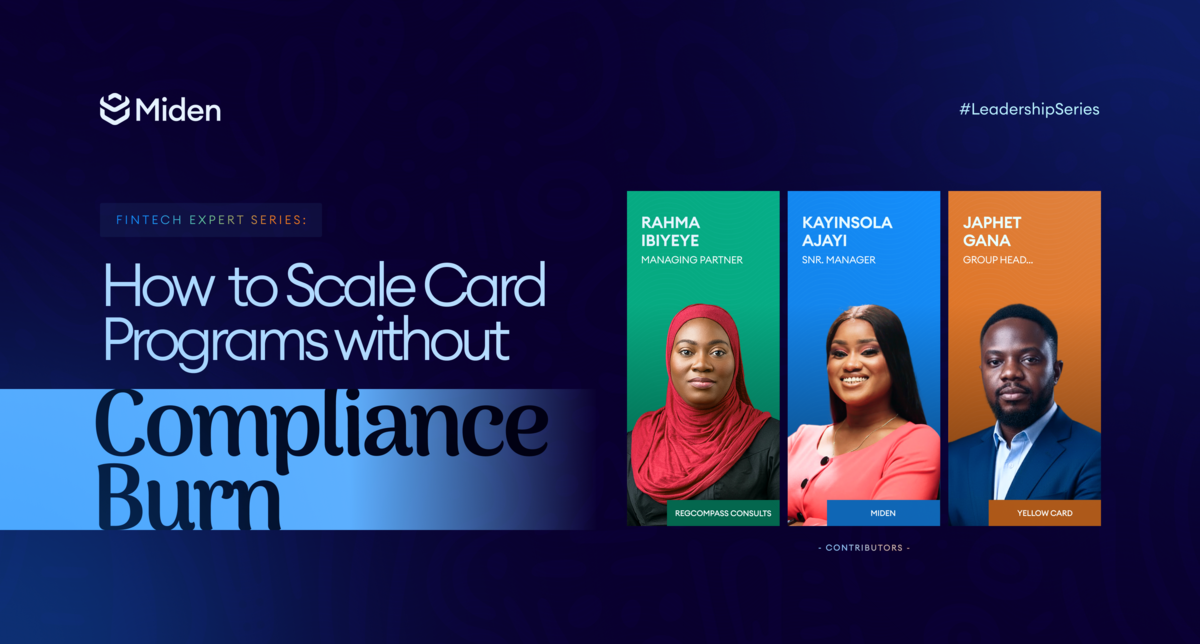
In this edition of our Fintech Expert Series, two industry leaders who manage risk, compliance, and card operations share what it actually takes to build a card program that survives regulatory scrutiny, bank partnerships, and real-world fraud.
Meet the experts:
- Japhet Gana, Head of Transaction Risk & Financial Crime at Yellow Card
- Kanyinsola Ajayi, Senior Manager, Operations at Miden
If you're building a card program, or just wondering how one works, this is for you.
So, How Does Compliance Work?
Oftentimes, fintechs treat compliance as a checklist. And oftentimes they end up feeling the legal heat.
The first fact about compliance is that it’s a structure, not a destination.
Japhet Gana, Head of Transaction Risk & Financial Crime at Yellow Card explains it best:
"At a minimum, fintechs will need to think in terms of end-to-end risk coverage, not just about isolated controls. For a card program, they need to look at the whole pillars starting from KYC and KYB, onboarding frameworks. And then you move to the transaction monitoring and financial crimes framework, down to sanctions screening, and finally dispute management."
Without these pillars in place, a card program operates on borrowed time.
What Sponsor Banks Actually Look For
Partner banks and card schemes do not just want compliance documents. They want proof that a fintech can operate within their risk appetite.
Kanyinsola Ajayi, Senior Manager, Operations at Miden, emphasizes that a clear governance structure must be established from day one.
This means explicitly defining who is responsible for what—whether it is the bank, the fintech, or the card scheme itself. All roles and expectations should be documented in a formal Service Level Agreement (SLA).
A critical insight from Kanyinsola points out that even if a fintech hands off certain tasks to third parties, it can never hand off final accountability. Fintechs must always maintain full end-to-end visibility. This allows it to share detailed operational insights with regulators and sponsor banks.
The 5 Core Pillars of a Scalable Card Program
A staple belief that fintechs need to let die, is the idea that processing comes first, and every other thing can wait.
Yes, processing is an important part of card programs, but it’s not an independent part.
Kanyinsola breaks down the structures needed to launch a successful card program:
"To run a successful card program, you need to focus on five core pillars. First, you need stable processing to make sure transactions flow smoothly without any glitches. Second, a strong KYC and onboarding system is essential for checking who your customers are and managing risk right from the start. Third, you must have real-time transaction monitoring and fraud controls to spot and stop suspicious activity as it happens. Fourth, precise reconciliation and settlement are vital so you always have an accurate view of your cash and where it is moving. Finally, an efficient dispute management system is necessary to handle customer claims quickly and stay within the strict timelines set by card schemes."...
Without these pillars, a card program will break under the first real test.
How to Build Fraud Management That Actually Works
Rule-based fraud systems are reactive. Machine learning systems are predictive.
Japhet emphasizes that building a strong fraud program starts with solid identity verification during onboarding. From there, fintechs must continuously monitor customer behavior to catch unusual patterns, such as spending spikes or transactions from unexpected locations.
Machine learning systems help spot these threats automatically in real-time, while clear internal rules like spending limits and velocity checks stop fraud before it escalates.
Fraud management is not a one-time setup. It is a continuous process of calibration.
Maintaining Accountability With Third-Party Processors
Outsourcing does not mean abdicating responsibility.
Kanyinsola stresses that to stay accountable while using third-party processors, fintechs must have end-to-end visibility into every transaction.
You can delegate operations to other companies, but you remain responsible for the results. Real-time data access is essential for answering regulator questions and enforcing internal rules. Legal contracts (SLAs) must clearly define roles and expectations.
To stay accountable while using other companies to process your cards, you need to see everything that is happening from start to finish. It is also important to have legal contracts (SLAs) that clearly say who does what.
This way, if something goes wrong, you are accountable to your customers and bank partners instead of just blaming the other company.
Audit Preparation Without Breaking Data Privacy
Audit logs are an operational necessity, not just a technical requirement. But many Fintechs don’t know this.
Japhet argues that audit preparation should start the day a fintech launches, not when an audit notice arrives. Compliance must become a normal part of daily work.
This means keeping written policies that match actual operations, maintaining logs that show who did what on systems, and recording how decisions were made and cases were handled.
To prove compliance, fintechs need to show patterns of good work through regular reports and have easy-to-find evidence; such as results from customer screening and transaction monitoring.
Audit Requirements for Card-Issuing Fintechs
Audit logs for card programs must be kept in one central place across all systems. This ensures that during an investigation, everyone is looking at the same, accurate information.
These logs cannot be changed or edited by anyone, which proves to regulators that data is safe, structured, and easy to access on demand.
The Overlooked Risk: Offboarding Policies
Every fintech company has onboarding checklists. Few to none have offboarding checklists. That is a problem.
Japhet emphasizes that a defined offboarding process is a core risk control, not a "nice to have" governance feature. When fraud or breaches are detected, fintechs must be able to quickly terminate access and revoke permissions for API keys, BIN access, and settlement rights.
"A defined offboarding process is a core risk control, not just a 'nice to have' governance feature. Many fintechs overlook this, but having a formal framework ensures the controlled exit of risky partners."
Just like offboarding an employee with a checklist, fintechs need a documented process to ensure every access point a partner had is removed. Keeping clear records provides vital evidence for audits and regulatory defense.
This policy should be reviewed at least once a year to stay updated as products and client types evolve.
What Effective Governance Looks Like
Clear responsibility and constant visibility are the twin pillars of effective governance.
According to Kanyinsola:
"The most effective governance structures rely on two things: clear responsibility and constant visibility. Every team must explicitly know what they are responsible for so that if an issue occurs, there is immediate accountability.
Additionally, you must have real-time visibility into your operations so you can spot and address problems yourself rather than waiting to hear about them from your customers."
Final Words on Card Operations for Fintechs
Launching a successful card program requires more than a great product and a sponsor bank.
The essentials are clear: a risk-based system for identity verification and real-time behavior tracking, a clear governance structure, dynamic risk scoring for customer spending limits, and careful vendor management.
But speed without structure loses money. Before launching, fintechs must have firm onboarding policies and a deep understanding of their end-to-end transactions.
This is why enterprises use Miden’s compliant financial system to power their entire payment and financial lifecycle in real time. Our API-first infrastructure gives companies the tools to move money, organize operations, and scale with confidence.
Get startedwith Miden today.